Comfrey plant: A naturopathic and evidence-informed guide to traditional uses, topical application and safety

Comfrey is a medicinal plant with a long history of traditional use in European herbal medicine.
Known scientifically as Symphytum officinale, comfrey has traditionally been applied externally to the skin in preparations intended to support areas affected by minor injuries, muscle discomfort, sprains, bruising and joint discomfort.
Its historical reputation is reflected in traditional names associated with the idea of helping damaged tissues recover.
Modern research has investigated topical comfrey preparations, particularly standardised comfrey root extracts, for several musculoskeletal applications.
However, comfrey also illustrates an important principle of evidence-informed herbal medicine: a plant can contain potentially useful compounds while simultaneously presenting significant safety considerations.
Comfrey contains pyrrolizidine alkaloids, naturally occurring plant compounds that can be harmful to the liver when sufficient amounts are absorbed into the body. For this reason, internal consumption of comfrey presents important safety concerns, and modern use focuses primarily on appropriately formulated topical preparations.
From a naturopathic perspective, comfrey should therefore not be viewed simply as a "natural remedy."
Its botanical identity, plant part, preparation, method of application, duration of use and safety profile all matter.
This guide explores comfrey, its traditional applications, important constituents, current evidence, topical uses and essential safety considerations.
In this guide, you will learn:
- What comfrey is.
- Which parts of the plant have traditionally been used.
- Important natural compounds found in comfrey.
- The traditional use of comfrey in herbal medicine.
- Why allantoin is frequently associated with comfrey.
- How comfrey has been studied for muscle and joint discomfort.
- Its potential role in minor sprains and strains.
- The traditional relationship between comfrey and skin support.
- The difference between comfrey root and leaf.
- Why pyrrolizidine alkaloids are important.
- Why internal use presents safety concerns.
- Important considerations for topical application.
- A naturopathic approach to using comfrey.
- When professional assessment is appropriate.
- Frequently asked questions.
- Practical safety considerations.
- Scientific references.
What is Comfrey?
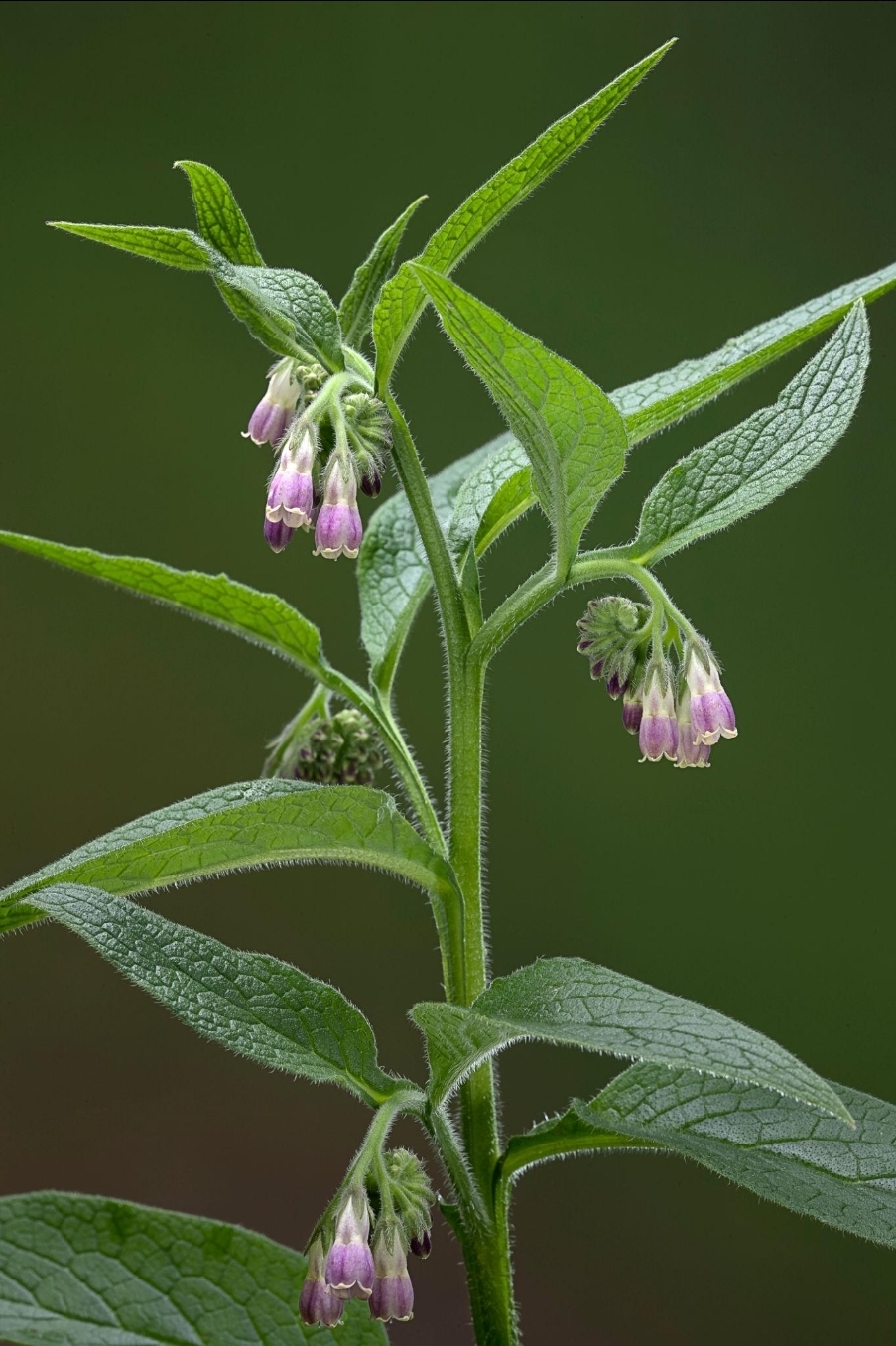
Comfrey is a perennial herb belonging to the Boraginaceae family.
Its scientific name is Symphytum officinale.
The plant is native to parts of Europe and Asia and has also become established in other regions.
Comfrey typically has:
Large, hairy leaves.
Thick stems.
Bell-shaped flowers.
A substantial root system.
Dark roots with a lighter interior.
The flowers may vary in colour and can appear purple, violet, pinkish, cream or white.
Comfrey grows particularly well in moist environments and is often found near riverbanks, ditches, damp grassland and other areas with moisture-rich soil.
Comfrey in traditional herbal medicine
Comfrey has been used in traditional herbal practices for centuries.
Historically, preparations made from the leaves or roots were used externally for concerns involving:
Bruising.
Sprains.
Strains.
Muscle discomfort.
Joint discomfort.
Minor skin injuries.
Localised swelling associated with minor injuries.
Its historical association with injuries contributed to traditional names suggesting the joining or knitting together of tissues.
Traditional use, however, does not by itself establish effectiveness or safety.
Modern herbal practice must consider contemporary evidence as well as the chemical composition and toxicological profile of the plant.
Important natural compounds in Comfrey
Comfrey contains numerous naturally occurring constituents.
These include:
Allantoin.
Rosmarinic acid.
Mucilage.
Tannins.
Phenolic compounds.
Pyrrolizidine alkaloids.
Different parts of the plant and different preparations may contain these compounds in varying concentrations.
This is important because herbal products cannot always be considered equivalent simply because they contain the same plant.
Extraction method, plant species, plant part, cultivation, processing and standardisation can influence the final composition.
Allantoin and Comfrey
Allantoin is one of the compounds most commonly associated with comfrey.
It is widely used in cosmetic and dermatological formulations and is associated with skin-conditioning properties.
The presence of allantoin is one reason comfrey has attracted interest in preparations designed for topical application.
However, comfrey is a complex botanical preparation.
Its effects cannot necessarily be attributed to allantoin alone, as extracts contain numerous compounds that may interact with biological tissues.
Comfrey and musculoskeletal comfort
One of the most researched modern applications of comfrey involves topical preparations for musculoskeletal discomfort.
Clinical studies have investigated specific comfrey root extract preparations for conditions involving pain and movement.
Research has included areas such as:
Back discomfort.
Joint discomfort.
Sprains.
Muscular discomfort.
Some clinical trials have reported improvements in pain or function with particular topical comfrey preparations.
Importantly, evidence obtained from a specific standardised extract cannot automatically be applied to every homemade comfrey preparation, cream, oil or herbal product.
The formulation and concentration used in clinical research may differ substantially from other preparations.
Comfrey and sprains
Topical comfrey root preparations have been investigated in people with acute ankle sprains.
Some studies have reported improvements in measures such as pain, tenderness, swelling and mobility.
This has contributed to modern interest in comfrey as a topical herbal option for certain minor musculoskeletal injuries.
However, an injury that causes severe pain, significant swelling, inability to bear weight, deformity or persistent symptoms requires appropriate assessment.
A herbal preparation should not be used to delay investigation of a possible fracture or significant ligament injury.
Comfrey and back discomfort
Specific topical comfrey root extract preparations have also been studied for acute back pain.
Clinical research has suggested that some preparations may help reduce discomfort when applied externally for a limited period.
From an integrative perspective, however, persistent back pain should be considered within a broader context.
Factors may include:
Physical activity.
Muscular strength.
Posture.
Occupational demands.
Previous injuries.
Sleep.
Body mechanics.
Stress.
Existing medical conditions.
Topical herbal preparations may form one component of supportive care but should not replace appropriate assessment when symptoms are severe, persistent or associated with neurological symptoms.
Comfrey and joint comfort
Comfrey preparations have also been investigated for joint-related discomfort, including symptoms associated with osteoarthritis.
Research on certain topical comfrey extracts has reported potential benefits for pain and physical function.
This does not mean that comfrey reverses joint degeneration or cures osteoarthritis.
From a naturopathic perspective, supporting joint health generally requires a broader approach that may consider:
Appropriate movement.
Muscle strength.
Body weight where relevant.
Nutrition.
Adequate protein intake.
Overall physical activity.
Recovery.
Management of existing health conditions.
Comfrey may therefore be considered as a topical supportive option rather than a replacement for comprehensive joint care.
Comfrey and skin support
Comfrey has a long history of external use in traditional herbal preparations for the skin.
Its traditional applications have included supporting areas affected by:
Minor superficial irritation.
Dry or rough skin.
Bruising.
Minor external injuries.
Comfrey contains allantoin, mucilage and other plant constituents that have contributed to interest in its use in topical formulations.
However, traditional use should not be interpreted as evidence that comfrey can treat every skin condition or accelerate the healing of serious wounds.
Skin problems that are persistent, infected, unexplained or severe require appropriate professional assessment.
Comfrey root and comfrey leaf
Both the root and leaves of comfrey have historically been used in herbal preparations.
However, they are not chemically identical.
The concentration of individual constituents can vary according to:
The part of the plant.
Plant age.
Growing conditions.
Harvesting period.
Species or variety.
Extraction method.
Manufacturing process.
Comfrey root is frequently used in standardised topical preparations investigated in clinical research.
The distinction between root and leaf is particularly important when considering pyrrolizidine alkaloids, because their concentrations can differ between different parts and preparations of the plant.
For this reason, it is inappropriate to assume that all comfrey products have identical properties or safety profiles.
Pyrrolizidine Alkaloids: an important safety consideration
One of the most important aspects of comfrey safety is the presence of pyrrolizidine alkaloids.
Pyrrolizidine alkaloids are naturally occurring compounds produced by various plant species.
Certain pyrrolizidine alkaloids can damage the liver after they are absorbed and metabolised by the body.
This is particularly relevant to comfrey because internal consumption can expose the body to these compounds.
Potential toxicity associated with pyrrolizidine alkaloids has led to significant restrictions and warnings regarding oral comfrey products.
From an evidence-informed naturopathic perspective, "natural" should never automatically be interpreted as "safe."
The chemical composition, dose, route of administration and duration of exposure are all important.
Why internal use of comfrey is a concern
Historically, comfrey was sometimes consumed internally as herbal tea, tinctures or other preparations.
Modern safety knowledge has substantially changed how the plant should be approached.
Because comfrey can contain potentially hepatotoxic pyrrolizidine alkaloids, internal use presents a risk of liver injury.
For this reason, drinking homemade comfrey tea or consuming comfrey preparations should not be considered equivalent to using an appropriately manufactured topical product.
The fact that a plant has been used traditionally does not eliminate toxicological risks identified through modern research.
A naturopathic approach should incorporate this safety information rather than relying solely on historical practice.
Topical comfrey preparations
Modern comfrey products intended for external use may be available in several forms, including:
Creams.
Ointments.
Gels.
Balms.
Some commercially manufactured preparations use extracts specifically produced or selected to minimise exposure to problematic pyrrolizidine alkaloids.
When considering a topical comfrey preparation, factors such as product quality, formulation, manufacturer instructions and intended duration of use are important.
Evidence from clinical trials generally relates to specific preparations.
It should therefore not automatically be assumed that homemade comfrey oil, homemade ointment and a standardised commercial extract will produce identical effects or present identical risks.
Comfrey and broken skin
Applying comfrey to broken or damaged skin requires particular caution.
A disrupted skin barrier may potentially alter the absorption of plant constituents.
Products containing comfrey should therefore be used according to their specific instructions.
Unless a properly regulated product specifically indicates otherwise, comfrey preparations should not simply be assumed to be suitable for:
Deep wounds.
Open wounds.
Significant burns.
Infected skin.
Large areas of damaged skin.
Serious wounds or signs of infection require appropriate medical care.
Comfrey during pregnancy and breastfeeding
Pregnancy and breastfeeding require additional caution with herbal products.
Because of concerns regarding pyrrolizidine alkaloids and insufficient safety information, comfrey should not be assumed to be appropriate during pregnancy or breastfeeding.
The absence of evidence demonstrating harm is not equivalent to evidence demonstrating safety.
Professional advice should be obtained before using medicinal herbal preparations during pregnancy or breastfeeding.
Comfrey and children
Children can respond differently to medicines and herbal preparations compared with adults.
Safety data for many herbal preparations are also more limited in children.
Comfrey products should therefore only be used in children when the specific product is appropriate for the child's age and its instructions explicitly permit such use.
Adult recommendations should not automatically be applied to children.
Duration of topical use
Herbal preparations are sometimes assumed to be suitable for indefinite use because they are natural.
This assumption is not appropriate for comfrey.
Duration of application matters because safety is related not only to what is applied but also to:
Concentration.
Frequency.
Amount.
Area of application.
Condition of the skin.
Duration of exposure.
Specific commercial products may provide limits regarding how frequently and for how long they should be used.
Those instructions should be followed.
Long-term continuous application should not be assumed to be appropriate simply because the preparation is topical.
Comfrey and liver health
The principal concern regarding internal exposure to comfrey relates to the liver.
Certain pyrrolizidine alkaloids can be metabolised into compounds capable of causing liver toxicity.
This is why the distinction between traditional internal use and contemporary safety recommendations is particularly important.
Someone with existing liver disease or other circumstances that may increase vulnerability should be especially cautious about herbal preparations containing potentially hepatotoxic constituents.
Comfrey should not be consumed internally as a self-directed strategy for supporting musculoskeletal or general health.
Comfrey in a naturopathic approach
From a naturopathic perspective, comfrey can be viewed as one potential topical botanical tool within a much broader approach to wellbeing.
The objective is not to rely on a single herb to address every musculoskeletal complaint.
For example, when supporting someone experiencing recurring muscular or joint discomfort, a broader assessment may consider:
- Physical activity.
- Mobility.
- Muscular strength.
- Previous injuries.
- Occupational demands.
- Nutrition.
- Hydration.
- Sleep.
- Recovery.
- Body weight where relevant.
- Stress.
- Existing medical conditions.
A topical herbal preparation may complement these foundations where appropriate.
The naturopathic principle should therefore be individualisation rather than assuming that one plant is suitable for everyone.
Comfrey Is not a substitute for diagnosis
Pain, swelling, bruising or reduced movement can have many different causes.
A topical herbal preparation cannot determine whether symptoms are caused by:
A minor muscular strain.
A ligament injury.
A fracture.
Arthritis.
Infection.
Nerve involvement.
Another underlying condition.
This distinction is important.
Comfrey may have a role in supporting certain minor musculoskeletal complaints, but it should not delay appropriate investigation when symptoms suggest a more significant injury or health condition.
When should you seek medical advice?
Professional assessment is particularly important when:
Pain is severe.
You cannot use or bear weight on the affected area.
There is obvious deformity.
Swelling is substantial or rapidly increasing.
A significant injury has occurred.
There is numbness or weakness.
The skin becomes increasingly red, hot or painful.
There is pus or another sign of infection.
Fever develops.
A wound is deep or extensive.
Symptoms persist or progressively worsen.
These situations require appropriate assessment rather than relying solely on topical herbal care.
Practical considerations for the safe use of Comfrey
When considering comfrey as part of a naturopathic approach, safety and product quality are important.
Consider the following:
Prefer appropriately manufactured topical preparations.
Follow the specific product instructions.
Do not assume that all comfrey extracts are equivalent.
Pay attention to whether the product uses root, leaf or another preparation.
Do not consume comfrey internally as a self-directed herbal remedy.
Avoid assuming that homemade preparations have the same safety profile as standardised commercial products.
Do not automatically apply comfrey to open, deep or infected wounds.
Do not exceed the recommended duration or frequency of application.
Seek professional advice regarding use during pregnancy or breastfeeding.
Ensure that a product is appropriate for the person's age before using it in children.
Stop using a topical product if significant skin irritation or another unexpected reaction occurs.
Seek assessment for severe, persistent or worsening musculoskeletal symptoms.
Do not use comfrey to delay investigation of a potentially significant injury.
Comfrey is an interesting example of the relationship between traditional herbal medicine and modern evidence-informed naturopathic practice.
Symphytum officinale has been used externally for centuries, particularly for concerns involving muscles, joints, bruising, sprains and minor injuries.
Modern research has provided some support for specific topical comfrey preparations in certain musculoskeletal applications.
At the same time, modern toxicological knowledge has identified an important limitation.
Comfrey contains pyrrolizidine alkaloids, some of which can cause liver toxicity when sufficient amounts enter the body.
For this reason, the traditional history of internal comfrey use should not be interpreted as evidence that consuming the plant is safe.
From a naturopathic perspective, responsible herbal medicine requires more than knowing what a plant was traditionally used for.
The species, plant part, extraction method, formulation, route of administration, dose, duration, individual circumstances and available scientific evidence all matter.
Comfrey may have a place as an appropriately selected topical botanical preparation within an integrative approach to minor musculoskeletal discomfort.
However, it should complement rather than replace appropriate assessment, movement, nutrition, recovery and conventional healthcare when required.
Frequently asked questions
- What is comfrey traditionally used for?
- Comfrey has traditionally been used externally in herbal medicine for minor musculoskeletal complaints, including bruising, sprains, strains, muscle discomfort and joint discomfort. Modern clinical research has also investigated specific topical comfrey preparations for some of these applications.
- Can comfrey be used for joint discomfort?
- Certain topical comfrey preparations have been studied for joint-related discomfort, including symptoms associated with osteoarthritis. Some studies have reported improvements in pain and physical function. However, this does not mean that comfrey repairs joint degeneration or cures osteoarthritis.
- Can comfrey help with muscle discomfort?
- Topical comfrey preparations have traditionally been used for muscular discomfort, and specific extracts have been investigated for musculoskeletal applications. The potential benefit depends on the preparation, concentration and circumstances in which it is used. Persistent or unexplained muscle pain should be appropriately assessed.
- Can comfrey be used for sprains?
- Specific topical comfrey root extract preparations have been studied in people with acute ankle sprains. Research has reported potential benefits for symptoms such as pain, tenderness, swelling and mobility. However, severe pain, inability to bear weight, significant swelling or deformity may indicate a more serious injury requiring professional assessment.
- Can comfrey be used for back discomfort?
- Specific topical comfrey root preparations have been investigated for acute back pain. Some clinical studies have reported reductions in discomfort. Persistent, severe or recurrent back pain, particularly when associated with weakness, numbness or other neurological symptoms, requires appropriate assessment.
- Is comfrey good for the skin?
- Comfrey has traditionally been included in topical preparations intended to support the skin. It contains constituents such as allantoin that are associated with skin-conditioning properties. However, comfrey should not be assumed to treat every skin condition, and significant, persistent or infected skin problems require appropriate assessment.
- Can comfrey be applied to an open wound?
- Comfrey should not automatically be applied to open or significantly damaged skin. A compromised skin barrier may affect the absorption of plant constituents. The instructions of the specific topical product should always be followed. Deep, infected or significant wounds require appropriate medical care.
- Can you drink comfrey tea?
- Internal use of comfrey presents important safety concerns because the plant can contain pyrrolizidine alkaloids associated with liver toxicity. For this reason, comfrey tea should not be considered a safe self-directed alternative to topical preparations.
- Is comfrey safe for the liver?
- The principal safety concern with internal comfrey exposure is potential liver toxicity from certain pyrrolizidine alkaloids. This is one of the main reasons why contemporary use focuses on appropriately formulated topical products rather than oral consumption.
- Are comfrey root and comfrey leaf the same?
- No. Although both come from the comfrey plant, their chemical composition can differ. The concentrations of pyrrolizidine alkaloids and other constituents may vary according to the plant part, species, harvesting conditions and processing method. Evidence relating to one particular comfrey extract should therefore not automatically be applied to every comfrey preparation.
- Can comfrey be used every day?
- The appropriate frequency and duration depend on the specific product and formulation. Comfrey should not automatically be considered suitable for indefinite daily application. The manufacturer's instructions regarding frequency, duration and area of application should be followed.
Important Disclaimer: This article is provided for general educational and informational purposes only. It is not intended to diagnose, treat, cure or prevent any medical condition and should not replace advice from a doctor or appropriately qualified healthcare professional. Supplements and natural products may cause side effects or interact with prescription medicines. Always seek appropriate professional advice before starting a new supplement or treatment, particularly if you have an existing medical condition or take medication.
References
- European Medicines Agency (EMA). Symphytum officinale L., radix – European Union Herbal Monograph. https://www.ema.europa.eu/en/medicines/herbal/symphytum-officinale-radix
- Giannetti BM, Staiger C, Bulitta M, Predel HG. Efficacy and Safety of Comfrey Root Extract Ointment in the Treatment of Acute Upper or Lower Back Pain: Results of a Double-Blind, Randomised, Placebo-Controlled, Multicentre Trial. British Journal of Sports Medicine. 2010;44(9):637–641. https://pubmed.ncbi.nlm.nih.gov/19460762/
- Grube B, Grünwald J, Krug L, Staiger C. Efficacy of a Comfrey Root Extract Ointment in the Treatment of Patients with Painful Osteoarthritis of the Knee: Results of a Double-Blind, Randomised, Bicenter, Placebo-Controlled Trial. Phytomedicine. 2007;14(1):2–10. https://pubmed.ncbi.nlm.nih.gov/17169539/
- National Center for Complementary and Integrative Health (NCCIH). Comfrey. https://www.nccih.nih.gov/health/comfrey
- Predel HG, et al. Efficacy of a Comfrey Root Extract Ointment in Comparison to a Diclofenac Gel in the Treatment of Ankle Distortions. Phytomedicine. 2005;12(10):707–714. https://pubmed.ncbi.nlm.nih.gov/16222647/
- Staiger C. Comfrey: A Clinical Overview. Phytotherapy Research. 2012;26(10):1441–1448. https://pubmed.ncbi.nlm.nih.gov/22359388/